
Go With Their Passions First
Go With Their Passions First, Then Build Accountability Without Shame
With disengaged and neurodivergent kids, you start with the rapport, the passions and the why. Only after that do you build accountability, and you build it without shame, so the kid ends up owning their own show and gets unstuck. Skip the first part and the second part never lands.
I run Action Pact Coaching, a mostly virtual executive functioning coaching company. We work with neurodivergent kids, students and failure-to-launch young adults, and with their families. Here is how it goes, step by step.
Why they check out?
Underneath a lot of this, especially with our youth, is the feeling that they simply don't count.
The apathy is extreme, and they've talked themselves into it. They tell you to get off their back, because they figure they have every reason to want out. Their reasoning is that the world stinks.
Open a session by telling them their parents hired me to get them more organized, and they're out the door, in their head and in their body.
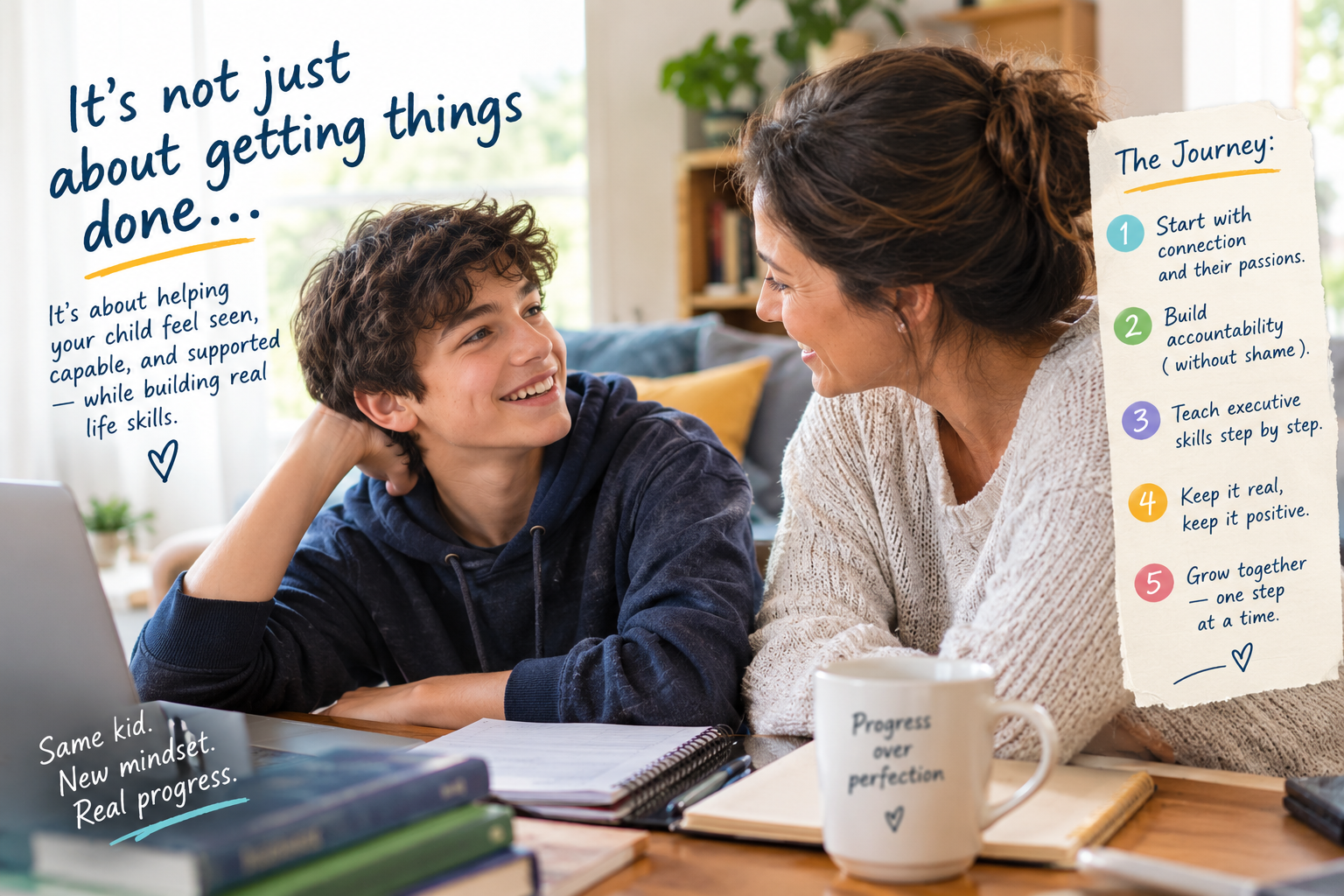
Step one: rapport, passions, the why
Years back I got on my first FaceTime call with a 10th grader. He told me flat out that he didn't know why he was there and didn't want to be. We were supposed to be working on writing. He hated school and saw no value in it, certainly not in writing. So I asked what fills his time. He goes, "oh, I love selling sneakers on the sneaker stock market." I knew nothing about it, and I told him so. That flips the switch. Now the kid is coaching me. After that I handed him a method for better writing, one that carries over to any discipline, whether he stays in school or just goes to a job. Everybody has to communicate and write. I modeled the system too, because telling a kid something might not land, but showing does. The system was a smashing success, and the reason was simple: he was writing about what he cared about. The whole point is to shock the kid into being interested. Piano, lacrosse, clarinet, dancing, whatever the passion is, the approach is the same. The homework comes first I do tons of research before I ever start. Parents are honest with me, to their credit, on a whole host of questions, and I should have a feel for the kid well before we talk face to face. That's my job. If I've learned he's a running back, I'll show him a few minutes of video of the top NFL running backs. With a baseball player, I may have a bat in my hand as the call connects, and I say, give me your best pitch. They're like, well, that's cool.
Step two: aim the toolkit at what they want
Get the rapport right and now we can work on what I was hired for. That's executive functioning, organization, self-advocating, clearer communicating, and owning their own show and their own chores. Those are what the ADHD and neurodivergent world calls non-preferred tasks. Chores. Nobody wants to do a chore, usually. On their own, many neurodivergent people dodge them because they're not fun. So I'll ask whether they'd like more and more time with a girlfriend, let's just say. Every time, the answer is an enthusiastic yes. Then I tell them that getting organized with the toolkit I provide frees up that time, because owning your own show takes less time.
Step three: daily accountability
We require a daily text from every client, Saturdays and Sundays too, at one set time, laying out the plan for the day. There's your accountability. In a session, everything gets done in real time. "I'll do it later" is their famous line, and it means it's not getting done. It's just the bottom line. Words like perhaps, might and maybe are off the table with me. If someone says they can do it, I point out that I never asked that. I asked whether they will. What honesty looks like Last year a Harvard senior, a math major named Jim, texted me midweek that he'd put in five hours at the library and felt great. I wrote back, great. Two days later, on Friday, he wrote, "I failed." I told him we'd talk it through at our Monday meeting, and to enjoy his weekend. Do what you do, whatever. Then, sitting across from each other, I gave him the possibilities. One, he was at the library five hours but his phone was on the whole time. Two, he fibbed in the text and put in a single hour. Three, he skipped the office hours we'd discussed. Four, he only worked the review sheet problems he already knew and avoided the rest. Which one was it? He admitted it was pretty much all four. Rapport gets you honesty, and honesty is what we need to get better.
Step four: no shame, just repair
Parents often go with "What were you thinking?" That is shame. A neutral outsider, a coach, a therapist, whatever, works better. They can say, got you, I understand what's happening here, and move straight to repair and action. When I inherit a kid with tons of missing work, I don't sit there and shame or blame. I keep it a safe, fun environment. Then I say, let's develop a list and then let's prioritize it. And then let's check those items off.
Step five: the family contract
Before the engagement starts, we write a family contract. It can be simple. It has to be enforced, everyone signs it, and I keep a copy, which lets me enforce it as well. It might say: text Jared every day, don't miss any sessions, don't be late, because after 10 minutes it's a done session. The beauty is that it's not punitive. You can earn stuff back. I have one guy who loves cheeseburgers, and a good week means three cheeseburgers from that place. One copy goes on the refrigerator in the kitchen, another in the kid's bedroom. After a week where the kid dropped the ball in too many areas, you skip the discussion, the conflict and the negotiation, none of which is healthy. The parent just points at the contract and says, dude, you didn't do it this week, so no cheeseburgers, but you can get them next week. I've seen the houses with the yelling, the punishing and the slamming doors. When this works, it becomes "look at our agreement." The attitude is, if you help me, I'll help you. Getting unstuck Not staying stuck. That's the key. Most people feel stuck, even many adults, especially in the current world. The release of the stuck is what we're trying to offer. The company is called Action Pact Coaching for a reason: buy-in, and co-creating your future as a pact. That's partnership. Let's have fun and get things done. Got a kid who's stuck? Reply and tell me what that looks like at your place.